
 English
 Français
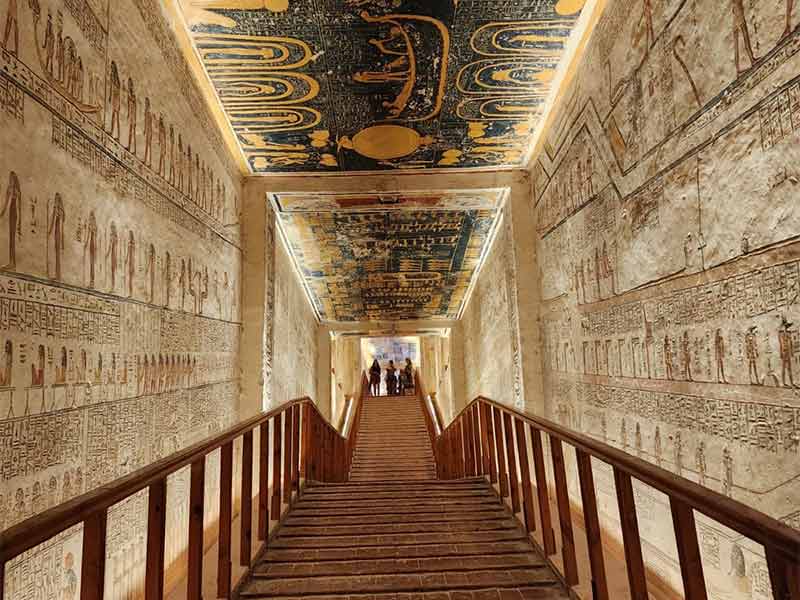
Valley of the Kings: 5 Famous Tombs and Visitor Guide
Compare five remarkable royal tombs, understand what makes each one different, and plan your Luxor visit around current admission rules, heat and changing tomb rotations.
The Valley of the Kings 5 tombs featured in this guide represent different periods, layouts and decorative traditions: Tutankhamun (KV62), Seti I (KV17), Ramesses III (KV11), Ramesses VI (KV9) and Ramesses IX (KV6).
The Valley contains more than sixty known tombs and additional unfinished chambers, so no five-tomb list can be definitive. This selection balances historical importance, visual interest and the questions travelers most often ask—but tomb availability and separate-ticket rules must always be checked on the day.
Why was the Valley of the Kings chosen?
New Kingdom rulers of Egypt’s Eighteenth, Nineteenth and Twentieth Dynasties were buried in this dry valley across the Nile from ancient Thebes. Its position in the west carried funerary meaning because the setting sun was associated with death and renewal. The surrounding cliffs also contain a pyramid-shaped peak, reinforcing ideas of rebirth and eternal life.
The valley’s isolation offered some protection, although ancient robbery still affected many tombs. Instead of building highly visible pyramids, royal burials were cut into the rock and paired with separate mortuary temples on the edge of the cultivated land.
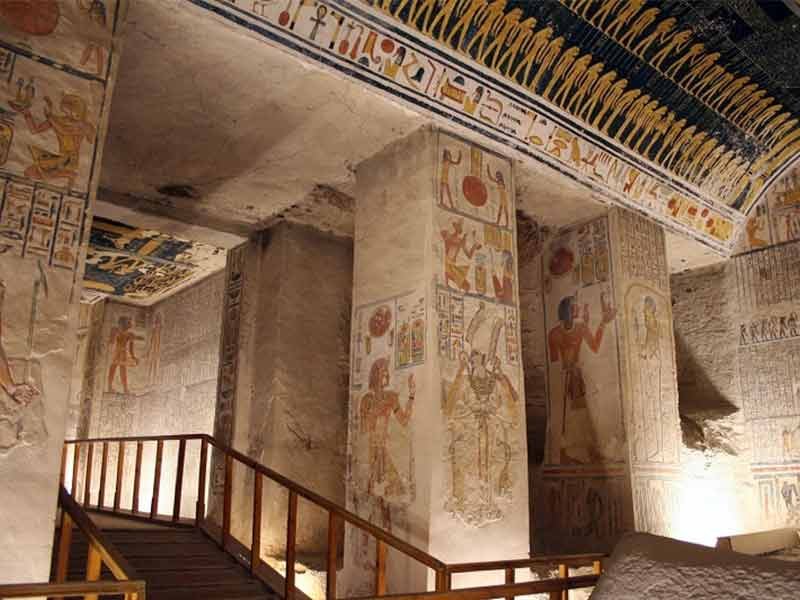
5 famous tombs in the Valley of the Kings
Tomb of Tutankhamun — KV62
Howard Carter and his team discovered Tutankhamun’s tomb in 1922. It became world-famous because it was found relatively intact and contained approximately 5,000 objects. The tomb itself is modest in scale compared with many royal burials, probably because Tutankhamun died young after a short reign.
Only the burial chamber carries extensive decoration. Visitors should not expect to see the golden mask or the original burial collection here; the objects were removed for conservation and museum display. The appeal of KV62 is its archaeological story, compact burial chamber and direct connection with the discovery.
Tomb of Seti I — KV17
KV17 is among the longest, deepest and most extensively decorated tombs in the valley. Seti I’s artists covered its chambers with refined painted reliefs and funerary compositions including the Litany of Re, the Amduat and the Book of Gates.
The vaulted burial-chamber ceiling is decorated as a night sky, while a passage descends beyond the chamber into the earth. This is the strongest choice for visitors primarily interested in craftsmanship and a complete royal decorative program, but it normally requires a substantial additional ticket.
Tomb of Ramesses III — KV11
KV11 was begun for Setnakht and later adapted for his son Ramesses III after the original cutting encountered an earlier tomb. The altered axis is one clue to this complicated construction history.
Its decoration draws on major royal funerary books, while side rooms contain unusual scenes connected with food preparation, equipment and offerings. These details make KV11 valuable for understanding both royal afterlife beliefs and the material provisions imagined for eternity.
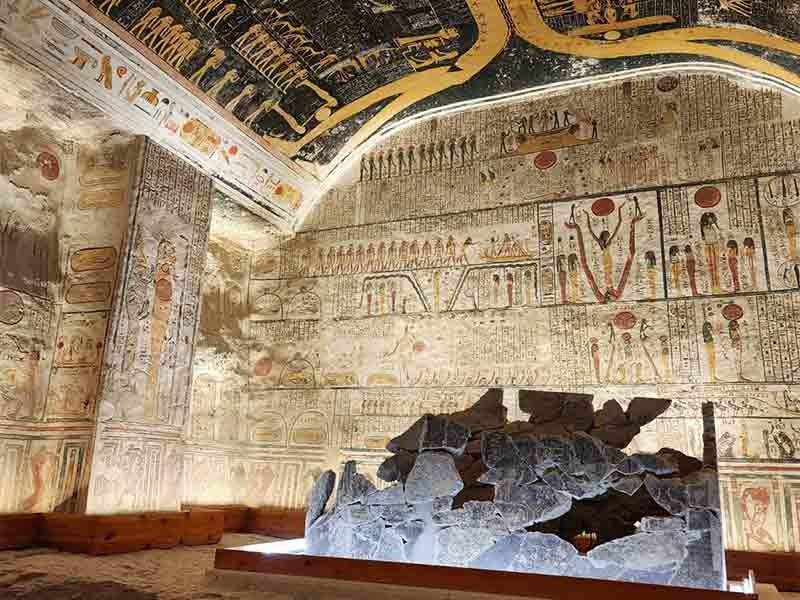
Tomb of Ramesses VI — KV9
This straight-axis tomb was started for Ramesses V and enlarged for Ramesses VI. Its well-preserved program includes the Book of Gates, Book of Caverns, Amduat, Book of the Earth and Books of the Heavens.
The dramatic astronomical ceiling and the double image of the sky goddess Nut make KV9 one of the most memorable tombs for visitors focused on ancient Egyptian cosmology. It usually requires a separate ticket from the standard valley admission.
Tomb of Ramesses IX — KV6
Located close to the main visitor route, KV6 has a broad entrance and a relatively straightforward sequence of corridors. Its walls and ceilings draw on funerary texts including the Book of Caverns, Book of the Earth and Amduat.
The tomb was known in antiquity, and historic graffiti records centuries of visitors. Its convenient position and visible decoration often make it a practical inclusion when it is open under the standard ticket.
How the five tombs compare
Tomb | Main reason to visit | Scale | Ticket note |
|---|---|---|---|
Tutankhamun, KV62 | Discovery story and relatively intact burial | Compact | Usually separate admission |
Seti I, KV17 | Exceptional painted reliefs and complete decoration | Very long and deep | Premium separate admission |
Ramesses III, KV11 | Long plan and unusual side-room scenes | Large | May be part of rotating standard selection |
Ramesses VI, KV9 | Astronomical ceiling and cosmological texts | Long, straight axis | Usually separate admission |
Ramesses IX, KV6 | Convenient route and clear decorative program | Moderate | May be part of rotating standard selection |
Valley of the Kings tickets and opening hours
Standard admission
The main ticket normally permits entry to a limited number of tombs from the standard group rather than every open tomb. The exact selection may rotate for conservation.
Additional tickets
High-demand or conservation-sensitive tombs such as Tutankhamun, Seti I and Ramesses VI commonly require separate tickets. Buy the correct extras before entering the archaeological area.
Current official hours
The Egyptian Ministry’s monument page currently lists daily hours of 6:00 AM–5:00 PM. Seasonal, Ramadan and operational changes may apply.
Recommended duration
Allow roughly two to three hours for transport within the site and several tombs. Add time if you purchase premium tomb tickets or read the decoration closely.
A practical order for visiting the tombs
There is no universal “best” route because daily tomb openings and crowd levels change. Start by checking the board at the ticket office, then prioritize the tomb you most want to see.
If decoration is your priority
Begin with Seti I or Ramesses VI if you hold the required ticket, then use the standard admission for contrasting Ramesside tombs.
If history is your priority
Visit Tutankhamun first, then compare its compact plan with a longer tomb such as KV9 or KV11.
If mobility is limited
Ask staff which open tombs have shorter approaches and fewer steep stairs. Tomb access is not uniformly step-free.
If you have limited time
Select three contrasting tombs rather than rushing through every available option. Crowds can significantly affect visit time.
Valley of the Kings visitor tips
- Arrive early to reduce heat exposure and encounter fewer large groups.
- Carry water, a hat and sunscreen; shade is limited outside the tombs.
- Wear supportive shoes because entrances, ramps and stairs can be uneven or steep.
- Never touch painted walls. Oils and moisture from hands damage fragile surfaces.
- Follow current photography rules and staff instructions; restrictions can vary by tomb and equipment.
- Do not assume every famous tomb is open. Conservation rotations and closures are normal.
- Keep all tickets accessible until you leave, including any separate-tomb tickets.
- Visitors with respiratory, mobility or claustrophobia concerns should ask about depth and access before entering.
What to visit near the Valley of the Kings
A focused West Bank day can combine the valley with the Temple of Hatshepsut, Medinet Habu and the Colossi of Memnon. Avoid treating the Valley of the Queens as part of the same site: it is a separate necropolis with its own admission arrangements.
For a broader itinerary, compare Luxor tours or use the guide to things to do in Luxor. On the East Bank, the Karnak Temple guide explains a very different sacred landscape devoted to temples and ritual rather than royal burial.
Frequently asked questions
How many tombs are in the Valley of the Kings?
The valley contains more than sixty known tombs and additional unfinished chambers. Only a selection is open to visitors at any one time.
Which Valley of the Kings tomb is the best?
It depends on your interest. Seti I is outstanding for refined decoration, Ramesses VI for astronomical imagery, Tutankhamun for archaeological importance, and Ramesses III or IX for accessible Ramesside layouts when open.
Is Tutankhamun’s golden mask still inside the tomb?
No. The treasures removed from KV62 are museum objects. The tomb visit focuses on the burial chamber, decoration and the place where the discovery occurred.
Does one ticket include every tomb?
No. Standard admission normally covers a limited number of tombs from the regular group. Several famous tombs require separate tickets, and the open selection can rotate.
How long should I spend at the Valley of the Kings?
Two to three hours works for many visitors. Allow longer for premium tombs, detailed viewing, crowds or mobility needs.
Can I take photographs inside the tombs?
Photography rules can change and may depend on the device or tomb. Follow the current ticket conditions, posted signs and instructions from site staff.
Is the Valley of the Queens inside the Valley of the Kings?
No. It is a separate archaeological site with its own tombs and ticketing. It should be planned as an additional West Bank stop.
Is the site suitable for visitors with limited mobility?
Conditions vary considerably. The valley approach has visitor transport, but many tombs include slopes, steps, narrow passages or deep descents. Ask staff which open tombs are most manageable.
Explore Luxor’s West Bank with an Egyptologist
Plan a well-paced route through the Valley of the Kings, Hatshepsut’s temple and other West Bank monuments with guiding and transport tailored to your schedule.
Explore Luxor Tours


Comment (0)