

 English
 Français

Karnak Temple Information: History, Highlights and Visitor Guide
Learn how this vast sacred complex developed, what not to miss, and how to plan a comfortable visit to one of ancient Thebes’ most important sites.
Karnak Temple information can be confusing because Karnak is not a single temple. It is a layered complex of pylons, courts, chapels, obelisks, sacred lakes and sanctuaries on Luxor’s East Bank. Generations of rulers enlarged and altered it, creating an architectural record of Egyptian religion and royal power.
This practical guide covers the history, principal monuments, opening hours, ticket guidance, ideal visit length and useful planning tips.
Why is Karnak Temple important?
Karnak stood within ancient Thebes, now represented by Luxor and its archaeological landscape. It became the principal cult centre of Amun-Re as Thebes rose in political influence. Rulers used its architecture, inscriptions, statues and processional routes to express devotion and legitimate their authority.
The ancient name Ipet-sut is generally translated as “The Most Select of Places.” Today, Karnak is part of the UNESCO World Heritage property Ancient Thebes with its Necropolis, inscribed in 1979.

A brief history of Karnak Temple
The visible complex is the product of construction, demolition, reuse and restoration across many periods, not the work of a single pharaoh. Important remains go back to the Middle Kingdom, while much of today’s monumental architecture reflects the New Kingdom, when Thebes was at the centre of royal and religious life.
Middle Kingdom foundations
Senusret I is among the earliest rulers securely associated with substantial building at Karnak. Later kings built over or reused earlier structures.
New Kingdom expansion
Hatshepsut, Thutmose III, Amenhotep III, Seti I and Ramesses II transformed the complex through pylons, halls, courts, obelisks and inscriptions.
Later additions
Nubian, Late Period and Ptolemaic rulers continued to build and restore the sacred precinct. Roman-period activity also left evidence.
Reused monuments
Blocks from dismantled structures were reused inside later buildings, helping archaeologists reconstruct monuments that had otherwise disappeared.
What to see at Karnak Temple
The principal route passes through monumental gateways and courts toward increasingly restricted sacred areas. Look beyond the scale for surviving pigment, erased names, ritual scenes and altered masonry.
Ram-headed sphinxes and the First Pylon
The approach introduces the ram-headed sphinx associated with Amun. The huge, unfinished First Pylon opens into the Great Court.
Great Court and Ramesses III’s temple
The court contains remains of Taharqa’s kiosk and a compact processional temple built for Ramesses III, whose layout makes the sequence of an Egyptian temple easier to understand.
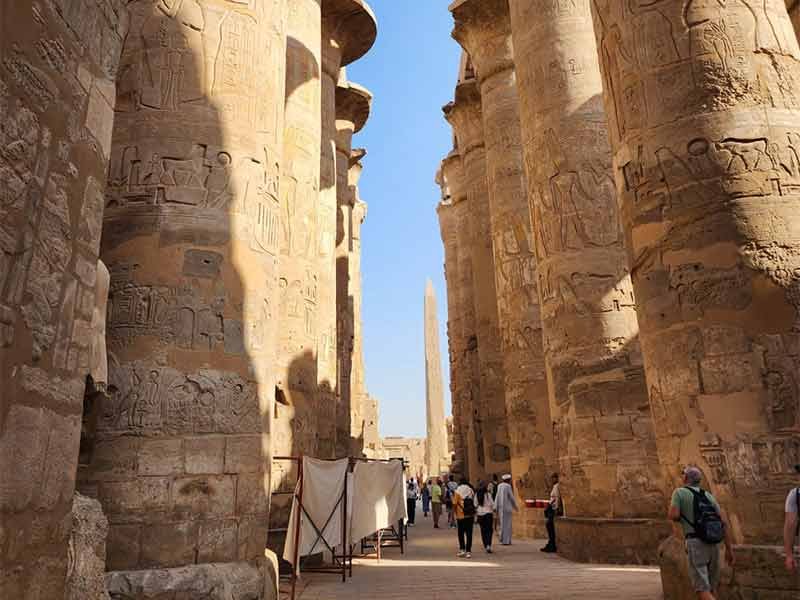
The Great Hypostyle Hall
Karnak’s most celebrated space contains 134 columns. Twelve taller central columns once supported a raised roof section with clerestory windows. Seti I and Ramesses II are closely connected with its decoration.
Obelisks of Thutmose I and Hatshepsut
These monolithic monuments expressed royal devotion to Amun and the solar aspect of the cult. Hatshepsut’s standing obelisk is especially notable for its scale and inscriptions.
Inner sanctuary and Festival Hall
Deeper in the complex are the granite barque sanctuary and the Festival Hall of Thutmose III, showing how successive rulers fitted new sacred architecture around earlier buildings.
The Sacred Lake
The lake was connected with priestly purification and temple ritual. It reminds visitors that Karnak functioned as a working religious institution, not simply a monumental façade.

Amun-Re, Mut, Khonsu and the Opet Festival
The Theban Triad
Amun-Re was Karnak’s leading deity and became closely tied to kingship and state power. Mut was his consort, and the lunar god Khonsu was their son.
The Opet Festival
During this major festival, sacred images travelled in ceremonial barques between Karnak and Luxor Temple. The procession renewed the relationship between Amun and the king and affirmed divine order.
Explore the wider East Bank through these Luxor tours, which can place Karnak, Luxor Temple and the Avenue of Sphinxes in their connected historical setting.

Karnak Temple opening hours, tickets and location
Visitor detail | Planning information |
|---|---|
Location | El-Karnak on Luxor’s East Bank, about 3 km north of Luxor Temple. |
Opening hours | The official Egyptian monuments page currently lists daily opening from 6:00 AM to 5:00 PM. Seasonal, Ramadan or operational changes may apply. |
Admission | The official listing currently offers an inclusive foreign-visitor ticket covering Karnak Temple and the Open-Air Museum, with reduced student admission. Prices can change. |
Visit duration | Allow around 2–3 hours for the main route. Archaeology enthusiasts may prefer half a day. |
Facilities | Basic facilities are available near the entrance. Carry water, sun protection and essential medication. |
How to plan your Karnak Temple visit
Best time of day
Early morning usually means cooler temperatures and a calmer route through the Hypostyle Hall. Late afternoon can offer warm light, but leave enough time before last entry and closing. Avoid midday during hotter months.
Combine Karnak with Luxor’s East Bank
A focused half-day can combine Karnak and Luxor Temple. If you also plan to cross the Nile, read the guides to the Valley of the Kings and Temple of Hatshepsut. Trying to cover every major East and West Bank site in one day can feel rushed.
Karnak Sound and Light Show
The evening show uses a separate ticket and schedule. It does not replace a daytime visit if you want to see reliefs and architecture clearly. Check current show times and languages before attending.
Practical Karnak Temple information and tips
- Wear supportive shoes because the route includes uneven stone and long walking sections.
- Carry water, a hat and high-SPF sunscreen; outdoor shade is limited.
- Visit the Hypostyle Hall early before larger tour groups arrive.
- Do not touch carvings or climb on monuments, even where barriers are absent.
- A licensed Egyptologist can make the site’s building phases and inscriptions easier to understand.
- Ask about permits before using tripods, professional equipment or commercial photography gear.
- Keep your ticket until the end because some areas may require another check.
Frequently asked questions about Karnak Temple
Is Karnak a single temple?
No. Karnak is a large complex containing several precincts, temples, chapels, pylons, courts, obelisks and sacred lakes. Most visitors explore the Amun-Re precinct.
Who built Karnak Temple?
No single ruler built it. Senusret I is linked to important early remains, while rulers including Hatshepsut, Thutmose III, Amenhotep III, Seti I and Ramesses II expanded or altered it.
How long does Karnak Temple take to visit?
Most visitors need two to three hours for the principal monuments. Allow longer to study inscriptions, explore additional open areas or tour with a specialist guide.
What is Karnak’s most famous feature?
The Great Hypostyle Hall is the best-known feature, with 134 columns, a raised central aisle, carved reliefs and surviving traces of colour.
Are Karnak Temple and Luxor Temple the same?
No. They are separate complexes on Luxor’s East Bank. A ceremonial avenue connected them, and both played roles in the Opet Festival.
Can I visit Karnak without a guide?
Yes, but the site’s many building phases can be difficult to interpret. A licensed guide or reliable plan helps connect the monuments into a clear sequence.
Is the Sound and Light Show included in admission?
Usually not. It is a separate evening event with its own ticket, times and language schedule. Confirm the current arrangements before going.
Is Karnak a UNESCO World Heritage Site?
Yes. Karnak forms part of “Ancient Thebes with its Necropolis,” inscribed on the UNESCO World Heritage List in 1979.
Explore Karnak with a private Egyptologist guide
Build a well-paced Luxor itinerary around Karnak, Luxor Temple and the West Bank, with guiding and transport tailored to your schedule.
Explore Egypt Day Tours

Comment (0)